Hall-Effect Vane Sensors in Automotive & Motorcycle Applications: Replacing Legacy Sensors with Modern ChenYang Solution
Shuang Qiu Comments 0 Comment
1. Introduction
This article provides:
- A short note on the working principle of Hall-effect vane sensors
- Typical automotive and motorcycle application scenarios
- Cross-reference table of discontinued models and ChenYang replacements
- Practical notes on selecting suitable replacement vane sensors
2. A Short Note on the Working Principle
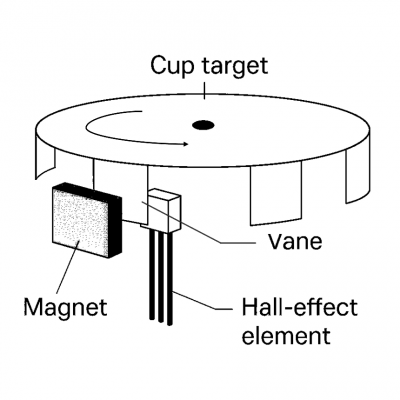
A Hall-effect vane sensor operates by mechanically interrupting a magnetic field with a moving vane. When the vane enters the sensing gap, it modulates the magnetic flux, causing the Hall element to switch cleanly between well-defined electrical states. As a result, vane sensors are especially suitable for applications that require precise timing edges and robust position feedback. One can visualize the basic structure of a Hall-effect vane sensor in the figure below, where a rotating cup target with vanes periodically modulates the magnetic field seen by the Hall element.
Compared with VR sensors or optical encoders, Hall-effect vane sensors offer several advantages:
- Produce stable outputs independent of rotational speed (no minimum RPM required)
- Unaffected by oil, dust, or contamination—ideal for harsh engine environments
- Excellent temperature stability, even in hot engine compartments
- Strong immunity to common-mode electrical noise thanks to inherent magnetic isolation
3. Typical Automotive & Motorcycle Use Cases
3.1 Vane Sensors in Distributor-Type Electronic Ignition Systems
Distributor ignition began to gain popularity in American cars around 1915, and subsequently spread to Europe and other regions. It was widely used in gasoline engines during the 1980s and 1990s, especially in older Volkswagen, Audi, SEAT, and other European models. These systems combine mechanical distribution with electronic triggering, forming a transitional stage between fully mechanical ignition and modern ECU-controlled systems. The graph below shows the schematic of a Distributor-type ignition system.
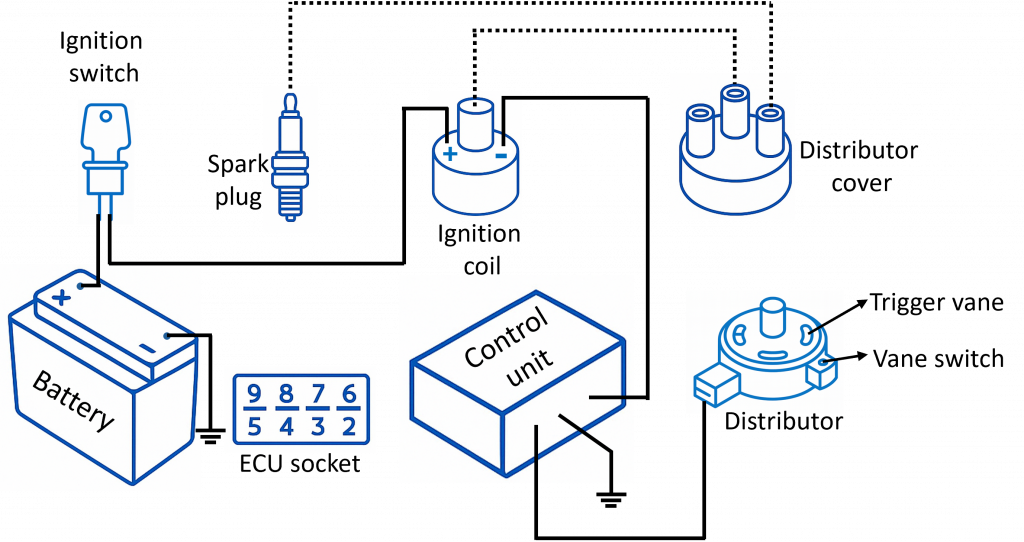
Working Principle of the Distributor-Type Ignition System
In this configuration, the camshaft drives a rotating distributor shaft. Mounted on this shaft is a multi-lobed cam or a rotating shutter wheel. As the shaft turns, the distributor performs two essential functions:
- Mechanical distribution of high voltage
A rotor inside the distributor cap directs ignition voltage to each spark plug in sequence. - Electronic triggering of ignition timing
Instead of older mechanical breaker points, many distributor systems use a Hall-effect vane sensor assembly to detect camshaft position and generate accurate timing signals for the ignition module.
When the engine rotates, the shutter wheel (or vane wheel) passes through the sensor gap. Each vane alternately blocks and unblocks the magnetic field. This produces a clean, digital Hall output signal that corresponds to specific crankshaft or camshaft angles. The ignition control unit uses these transitions to determine:
- spark timing
- engine speed
- correct cylinder sequence
In practical automotive use, this method is significantly more stable and durable than mechanical breaker points because it eliminates mechanical wear and provides precise electrical switching.
Role of the Hall-Effect Vane Sensor
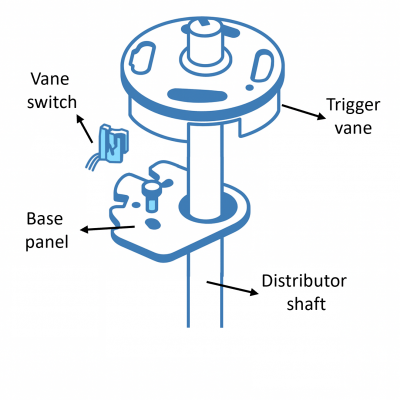
The picture above shows the internal mechanism of a distributor, including the rotating trigger vane mounted on the distributor shaft and the Hall-effect vane switch positioned next to it. When the solid metal portion of the rotating vane passes between the magnet and the Hall element, the sensor output drops to zero. When an opening in the vane allows the Hall element to be exposed to the magnetic field, a voltage pulse is generated. In this way, the Hall sensor produces one clean voltage pulse for every required spark event.
Within the distributor, the vane sensor serves as the primary timing reference. Its key functions include:
- Generating a precise trigger pulse each time a vane passes, enabling accurate ignition timing
- Providing engine speed feedback, as the pulse frequency is directly proportional to camshaft rotation
- Ensuring stable operation across contaminants, such as oil mist or dust inside the distributor housing
- Remaining accurate at low engine speeds, where VR sensors may produce weak or distorted signals
The sensor’s ability to generate strong, consistent transitions independent of RPM makes it ideal for cold starts, idle conditions, and low-speed operation where older mechanical or VR systems might struggle.
Legacy Vane Sensor Models Used in Distributor Systems
Many distributor-based ignition systems—especially in older VW/Audi/SEAT gasoline engines—were historically equipped with vane sensors manufactured by Siemens. Common part numbers included:
- Siemens HKZ101
- Siemens HKZ101S
- Siemens HKZ121
These models served as camshaft Hall pick-up sensors and were widely used across multiple engine platforms. However, all of them have since been discontinued, leaving a significant gap in the market for repair, maintenance, and restoration of vehicles that still rely on these distributor configurations. For service applications requiring a compatible replacement, modern equivalents such as the CYHME301 / CYHME301S Hall-Effect Vane Sensors can be used.
3.2 Classic Motorcycle Ignition Modules (e.g., BMW Boxer engines, Saab/Volvo ignition)
Motorcycle engines—particularly classic BMW Boxer models and early Saab/Volvo ignition systems—require reliable detection of rotational speed and camshaft phase under harsher mechanical conditions than typical passenger cars. Higher RPM, stronger vibration, and rapid load changes place greater demands on the stability of the ignition trigger. The photo below shows a schematic illustration of typical motorcycle ignition trigger assembly.
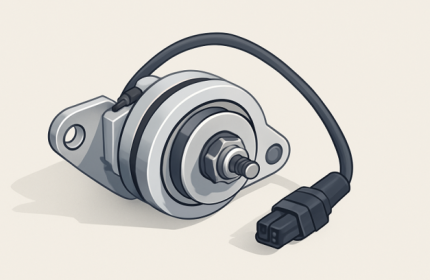
In these systems, a compact Hall-effect vane sensor is positioned next to a small trigger wheel mounted on the crankshaft or camshaft. As the engine rotates, each passing vane alternately blocks and exposes the magnetic field, generating clean switching pulses used by the ignition control unit to determine ignition timing and engine speed.
The vane sensor remains highly reliable in this environment because it produces stable signals even at very low RPM—an area where VR sensors often struggle. In addition, its magnetic shielding structure also provides strong immunity to oil mist, dust, and temperature fluctuations, conditions commonly found around motorcycle engine housings.
Legacy ignition modules in these applications frequently used Honeywell vane sensors such as:
- 2AV16A
- 2AV51A
- 2AV54
- 2AV56
All of these models are now discontinued, creating a need for long-term compatible replacements in maintenance and restoration work. ChenYang Technologies offers suitable Hall-effect vane-type replacements for these legacy modules, including the CYHME56 and CYHME56C series, which provide stable switching behavior and mechanical compatibility for retrofit applications.
3.3 Engines with Electronic Ignition & Fuel Injection
In early electronic ignition and fuel-injected engines, the control unit relies heavily on accurate speed and shaft-position information to synchronize fuel delivery and spark timing. A Hall-effect vane sensor mounted near the camshaft or crankshaft provides the essential trigger pulses that replace traditional breaker points, enabling fully electronic ignition control. As the trigger wheel rotates, each vane produces a clean on/off transition, allowing the ECU to determine engine speed, phase, and firing sequence with high precision.
Because fuel injection requires exact synchronization between injector timing and ignition events, the stability of the vane sensor’s output is critical. Its ability to generate consistent digital pulses—independent of low RPM or temperature variations—ensures that the ECU receives reliable timing information during idle, cold start, and transient load changes. Therefore, vane-type Hall sensors are a common choice in many early distributor-less and semi-electronic ignition systems.
Legacy systems in this category often used Honeywell 1AV-series vane sensors, including:
- 1AV11F
- 1AV12F
- 1AV13F
The picture below shows a classic Ducati 900 SS, representative of early Ducati motorcycles equipped with Ducati Energia electronic ignition modules. These systems often used Hall-effect vane sensors marked “Microswitch USA 1AV12F,” a Honeywell/Microswitch component widely applied in breakerless ignition and early ECU synchronization.

Historically, such sensors were designed with a typical maximum operating temperature of around 125 °C, which aligned with the engineering standards of that period. As engine designs evolved—particularly in air-cooled motorcycles and compact ignition housings—thermal conditions in some applications became more demanding. Consequently, modern replacement solutions increasingly benefit from extended temperature capabilities to accommodate these environments.
ChenYang’s CYHME1AV series is engineered with an upper operating-temperature limit of 150 °C, providing a robust option for users seeking a contemporary substitute for legacy vane-type Hall-effect sensors in ignition and fuel-injection systems.
3.4 Servo Motors and Industrial Drives Used in Automotive Systems
Although vane-type Hall sensors are best known for their roles in ignition and engine control, the same sensor families were also widely used in industrial drive mechanisms that support automotive production, maintenance, and component manufacturing. These systems—often involving compact servo motors, paper-feed mechanisms, or synchronized roller drives—require stable low-RPM feedback and clean switching pulses, particularly in electrically noisy factory or workshop environments.
A representative example is found in Heidelberg offset printing machines, where reproducible phase and speed feedback is essential for sheet feeding and roller synchronization. Many of these platforms were equipped with Honeywell 2AV63 and 2AV61 vane-type Hall sensors, which served as rotational feedback elements inside the drive assemblies. The sensor’s ability to generate well-defined digital transitions, independent of rotational speed, made it suitable for these slow-moving, continuously operated industrial mechanisms.
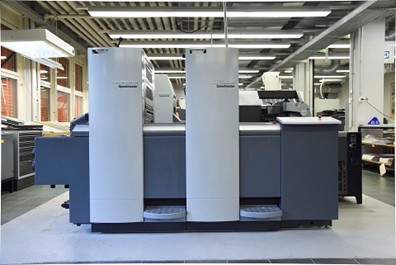
Because such printing and auxiliary drives remain in long-term service across automotive workshops, parts suppliers, and component-labeling facilities, the discontinuation of the original Honeywell 2AV-series sensors has created an ongoing need for reliable replacements. ChenYang’s CYHME56L vane-type Hall sensor provides a compatible alternative to the legacy 2AV61 and 2AV63 models, offering equivalent electrical functionality together with extended availability for long-term industrial support.
3.5 Ignition Pick-Up Sensors in SEAT / VW Compact Cars
Many compact gasoline engines produced by Volkswagen and SEAT during the 1980s and 1990s relied on a small Hall-effect vane sensor integrated into the ignition pick-up assembly. In these systems, the sensor provides a clean trigger pulse for ignition timing and basic shaft-position detection, allowing the ignition module or ECU to identify firing events and maintain stable spark timing across the full RPM range. The figure below shows a representative vehicle platform—the Volkswagen Golf Mk2, one of the most widely used compact cars equipped with this type of Hall pick-up sensor.

At the core of these distributor-based ignition systems is the pick-up plate containing a vane-type Hall sensor. As the shutter wheel rotates, each vane alternately interrupts and restores the magnetic field, generating sharp digital transitions for spark control. The second figure shows a schematic illustration of typical ignition pick-up module used in many VW/SEAT applications.
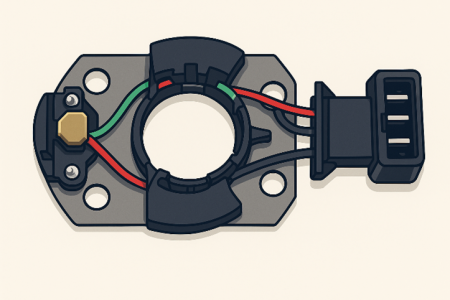
Models from this era commonly used Honeywell 2AV31E and 2AV31E-J sensors as the internal Hall-effect elements. These components were valued for their low-speed stability and resistance to oil mist inside the distributor housing. However, both models have long been discontinued, creating ongoing demand for compatible replacements in the maintenance of classic SEAT/VW compact cars still in operation. ChenYang’s CYHME2000 vane-type Hall sensor provides a direct electrical replacement for the legacy 2AV31E and 2AV31E-J models, supporting both restoration and continued service of these ignition systems.
4. Cross-Reference Table: Hall-Effect Vane Sensor Replacement Options
The table below summarizes practical, field-tested replacement options for obsolete or discontinued Hall-effect vane sensors originally supplied by Siemens, Honeywell and other manufacturers. These ChenYang vane sensors are drop-in electrical replacements for many legacy models widely used in vintage vehicles, motorcycles, servo drives, and industrial position-control systems.
Application / Vehicle |
Discontinued Sensor (Cross Reference) |
ChenYang Replacement |
|
Older VW / Audi / SEAT gasoline engines with distributor-type electronic ignition.
Commonly found in, e.g.,
• VW Golf Mk2 / Mk3 • Jetta Mk2 • Passat B3 / B4 • Audi 80 / 90 B3 / B4 • SEAT Toledo Mk1, etc. |
Siemens HKZ101 / HKZ101S / HKZ121
Hall pick-up sensor |
|
|
Classic BMW boxer motorcycles (e.g. R1100GS, R1150RT, R850R),
Saab 900 / 9000 and Volvo 850 / S70 / V70 camshaft / ignition Hall-vane sensors |
Honeywell 2AV16A, 2AV51A, 2AV54, 2AV56
Hall-effect vane sensors |
|
|
Engines with electronic ignition / fuel injection and other control systems –
Hall vane sensor for speed and position (breakless trigger, rpm and shaft sensing) |
Honeywell 1AV11F, 1AV12F, 1AV13F
Hall-effect vane sensors |
|
|
Siemens servo motors with Ø100 mm signal generators (3× 2AV63 Hall sensors),
offset printing machines and similar industrial drives
|
Honeywell 2AV61, 2AV63
Hall-effect vane sensors |
|
|
SEAT Arosa / Córdoba / Ibiza / Toledo / Alhambra / Inca –
ignition Hall pick-up / shaft position sensor.
Commonly found in, e.g.,
• Ibiza Mk2 / Mk3 • Toledo Mk1 • Córdoba Mk1 • Arosa Mk1 • Inca van • Alhambra Mk1, etc. |
Honeywell 2AV31E, 2AV31E-J
Hall-effect vane sensors |
Notes on Selecting an Appropriate Vane-Type Hall Sensor
When choosing a vane-type Hall sensor—either as a replacement for discontinued legacy components or for integration into new designs—the following technical considerations help ensure proper mechanical fit and reliable electrical performance:1. Mechanical Interface
- Verify mounting-hole diameter, flange geometry, and the overall sensor form factor.
- Check installation depth and the required air gap between the sensor and the rotating vane.
- Ensure that the vane width and gap geometry meet the magnetic modulation requirements of the sensing principle.
2. Electrical Specification
- Confirm the output type (NPN / PNP), open-collector behavior, and sourcing vs. sinking configuration.
- Match the intended supply-voltage range with the sensor’s rated operating limits.
- Verify the switching characteristics—digital on/off transitions or analog magnetic response—based on system needs.
3. Wiring & Pin Assignment
- Ensure the pin order / wire sequence follows the required logic (e.g., Vcc → Output → Ground).
- If the wiring sequence differs from the existing system, adapt the connector or use an interface harness.
- Confirm connector style and mechanical form (flying leads, PCB pins, sealed automotive plug, etc.).
4. Polarity & Magnetic Orientation
- Match the magnetic polarity and orientation (axial/radial) of the target design, otherwise switching edges may invert or fail to register correctly.
5. Application-Level Constraints
- For high-speed triggers (e.g., ignition or CDI systems), ensure the sensor provides adequate frequency response.
- For industrial or continuous-duty systems, check thermal rating, vibration tolerance, and environmental robustness.
5. Conclusion
Hall-effect vane sensors continue to play a critical role in automotive and motorcycle systems, particularly in ignition timing, camshaft and crankshaft position detection, and low-speed rotational feedback. Their inherent advantages—stable switching at low RPM, immunity to oil and dust contamination, strong temperature robustness, and reliable digital transitions—make them especially suitable for classic vehicles, distributor-type ignition modules, and a wide range of legacy industrial drives.
As many original models from Honeywell, Siemens, Bosch and other suppliers have been discontinued, the availability of dependable replacements has become increasingly important for maintenance, repair, and restoration tasks. ChenYang Technologies provides a comprehensive portfolio of vane-type Hall sensors that deliver:
- Stable and repeatable switching characteristics
- High build quality and long-term reliability
- Consistent and reliable supply, ensuring long-term service availability
This makes ChenYang a trusted replacement source for technicians, system integrators, classic vehicle owners, and industrial service teams seeking drop-in substitutes for older vane-sensor models.
If you are planning to replace a legacy sensor or are unsure which ChenYang model matches your application, we encourage you to contact our technical support team. Our engineers can help verify mechanical fit, electrical compatibility, wiring sequence, and performance requirements to ensure you select the correct model for your vehicle or system.