CYHCS-EKC: A Compact Split-Core Current Sensor for Accurate AC/DC Measurement
Shuang Qiu Comments 0 Comment
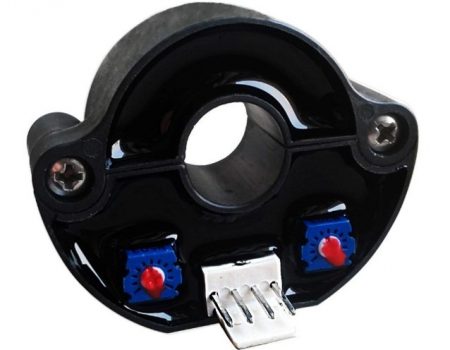
Modern power-conversion systems—such as photovoltaic inverters, energy-storage units, UPS systems, welding machines, and motor drives—place increasingly high demands on current-measurement reliability, electrical safety, and installation flexibility. Engineers also face growing pressure to deploy sensors quickly and non-invasively, ideally without disconnecting conductors or interrupting running equipment. This trend naturally drives the adoption of split-core current sensor, which allow the device to be clipped around an existing cable in seconds.
Against this background, ChenYang’s CYHCS-EKC split-core Hall-effect AC/DC current sensor offers a practical and cost-efficient solution. Its notably compact housing allows it to fit into tight electrical cabinets and crowded cable bundles, while the split-core structure enables quick mounting without disconnecting conductors. The sensor is lightweight, easy to mount, galvanically isolated, low-power, and fully compatible with AC and DC current measurement, while its open-loop Hall architecture provides an output that accurately reflects the real waveform of the primary conductor without introducing insertion losses.
This article gives a concise, practical overview of why split-core sensors matter in modern systems and how the CYHCS-EKC can be selected and applied effectively in real projects.
Table of Contents
1. Working Principle (Short Overview)
Open-loop Hall-effect current sensing measures the magnetic field generated by the current-carrying conductor and converts it into a proportional output voltage through a Hall element and amplifier.
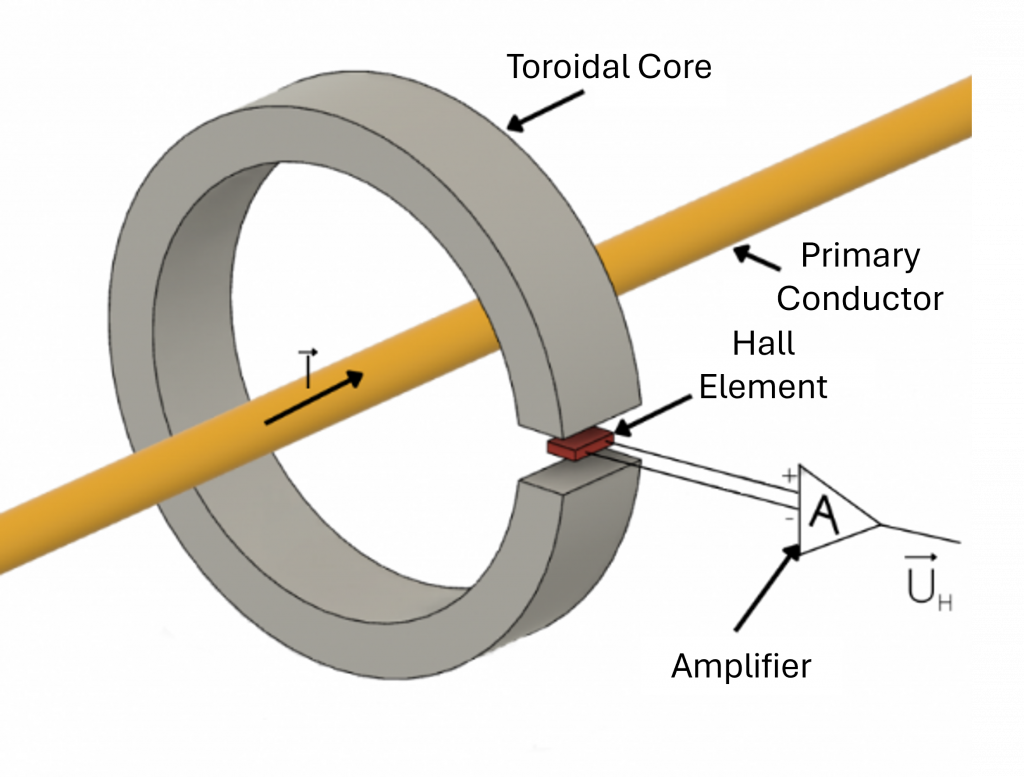
This diagram shows the basic physical arrangement used in open-loop Hall sensors: the primary conductor passes through the magnetic core, the Hall chip detects the resulting flux in the air gap, and the amplifier produces a voltage proportional to the primary current.
👉 For a more detailed explanation of the open-loop Hall-effect current sensing principle, see our dedicated article here: Hall Effect Current Sensors: An introduction
Because the Hall-effect element directly senses the magnetic field rather than relying on induction, the sensor can accurately measure AC, DC, and pulsed currents, making it suitable for power electronics, renewable-energy systems, UPS, welding machines, and many other load types.
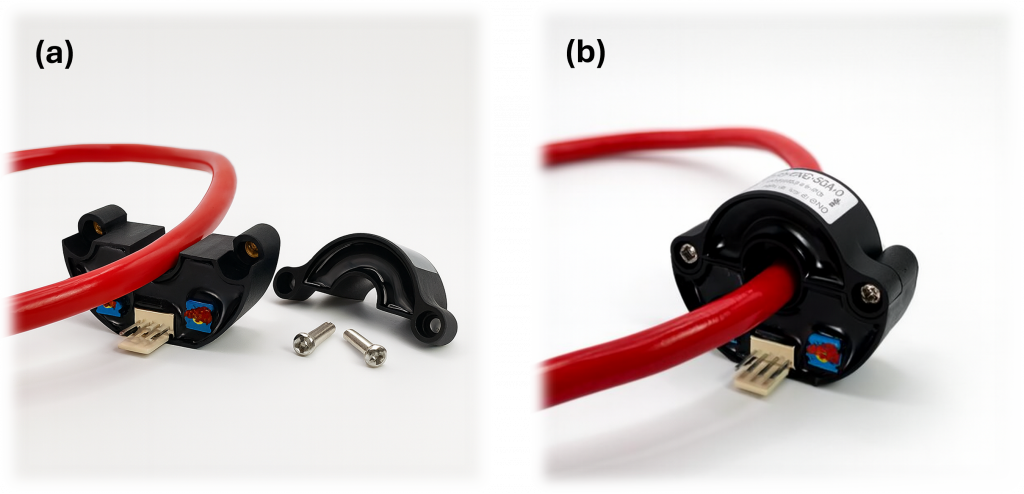
To enable fast, non-intrusive installation, CYHCS-EKC uses a split-core design: the core opens mechanically, allowing the sensor to be clipped around an existing cable without disconnecting the primary conductor.
2. Product Highlights & Performance
CYHCS-EKC is designed for applications that require high accuracy, stable long-term performance, and multiple current ranges from 30 A up to 300 A. The open-loop Hall architecture provides low power consumption and wide application compatibility, while the compact size and split-core form factor enables quick, non-intrusive installation in new or existing systems.
These key electrical specifications and available variants are summarized in the table below.
| Parameter | Value / Options |
|---|---|
| Primary Nominal Current Ir (A) | 30 A – 300 A |
| Primary Current Measuring Range Ip (A) | 0 ~ ±60 A – 0 ~ ±600 A |
| Accuracy | ±1.0% (all models) |
| Linearity | < ±1.0% FS |
| Output Voltage | ±4 V, ±5 V (depending on “x” code) |
| Supply Voltage | ±12 V ~ ±15 V DC |
| Operating Temperature | −25°C ~ +85°C |
| Mounting | Split-core, panel screw |
| Window Size | Ø12 mm (aperture) |
| Dimensions | 46 × 37 × 16 mm |
| Offset Voltage | < ±25 mV |
The CYHCS-EKC series is available in several nominal current ratings and output versions, allowing designers to match the sensor precisely to the expected load conditions of their system.
Practical Notes for Best Performance
To achieve the highest measurement accuracy and ensure reliable system integration, consider the following practical guidelines:
- Select the correct nominal range (Ir)
Each model supports a measurement range of approximately ±2 × Ir. Choose the nominal range such that typical operating current remains well within this window. - Fill the window as fully as possible
The best accuracy is achieved when the primary conductor (or busbar) fills the sensing aperture, minimizing magnetic offset and improving repeatability. - Observe the current-direction arrow
For in-phase output relative to the current waveform, ensure the conductor is inserted according to the arrow printed on the housing. - Offset and gain trimming
Two potentiometers (OFS and GIN) are available for fine adjustment if required. Only adjust them with a small insulated screwdriver and under stable current conditions. - Isolation and wiring considerations
The sensor provides galvanic isolation between primary and secondary circuits. Ensure correct wiring of V+, –V, OUT, and GND to avoid damage or incorrect readings.
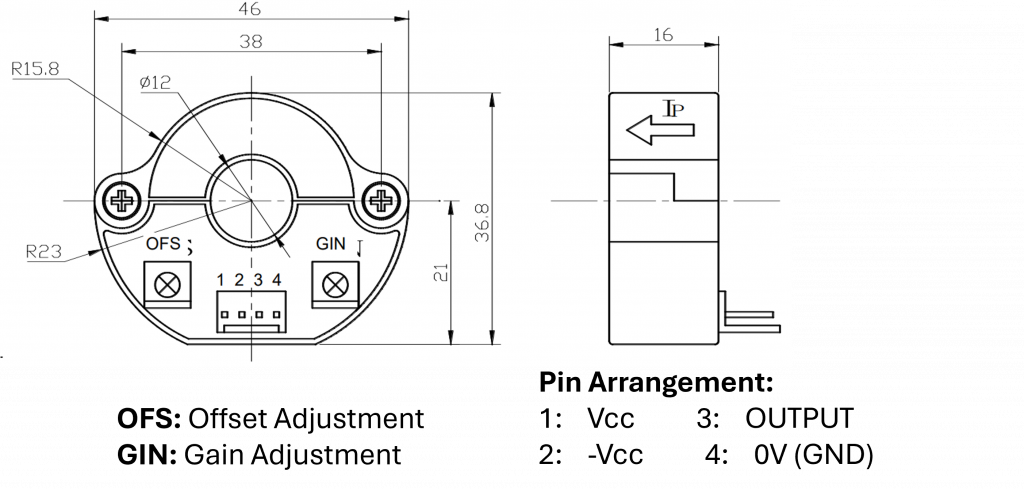
In addition to its electrical performance, one of the key advantages of the CYHCS-EKC is its exceptionally compact housing. With dimensions of only 46 × 37 × 16 mm, the sensor fits easily into crowded control cabinets, retrofit installations, and space-constrained industrial systems where conventional current transducers cannot be mounted. The diagram below shows the pin assignment, offset/gain adjustment locations, and key mounting dimensions of the CYHCS-EKC sensor, as specified in the official datasheet.
3. Application Scenarios
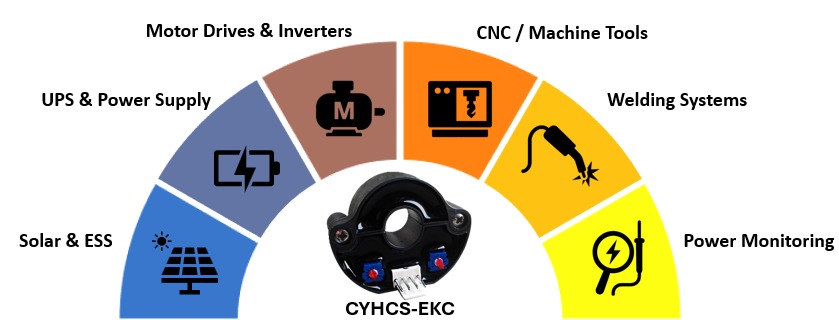
Representative Application Categories
- Photovoltaic & Renewable Energy Equipment
- UPS Systems & Power Supplies
- Frequency Conversion & Timing Equipment
- CNC Machines & Machine Tools
- Electric Welding Machines
- Power Network Monitoring Systems
4. Conclusion & Call-to-Action
CYHCS-EKC combines the practicality of a split-core structure with the performance of a precise Hall-effect current transducer. Its exceptionally small and compact housing makes installation possible even in crowded control cabinets or tightly packed cable environments, while its quick, non-intrusive clamp-on mounting, AC/DC measurement capability, high galvanic isolation, and lightweight, cost-efficient design make it a dependable choice for engineers working across renewable energy, power conversion, industrial control, and electrical safety monitoring.
For readers interested in integrating CYHCS-EKC into their systems, the following resources are available:
- Download the datasheet for full electrical and mechanical specifications.
- Visit the product page to review compatible variants (30 A to 300 A) and technical notes.
- Contact our technical support team for application guidance, customization options, or engineering questions.
This product is available in our online shop and can be purchased directly.