CYGM99A Digital Gaussmeter — Practical Magnetic Field Measurement for Engineering Applications
Shuang Qiu Comments 0 Comment
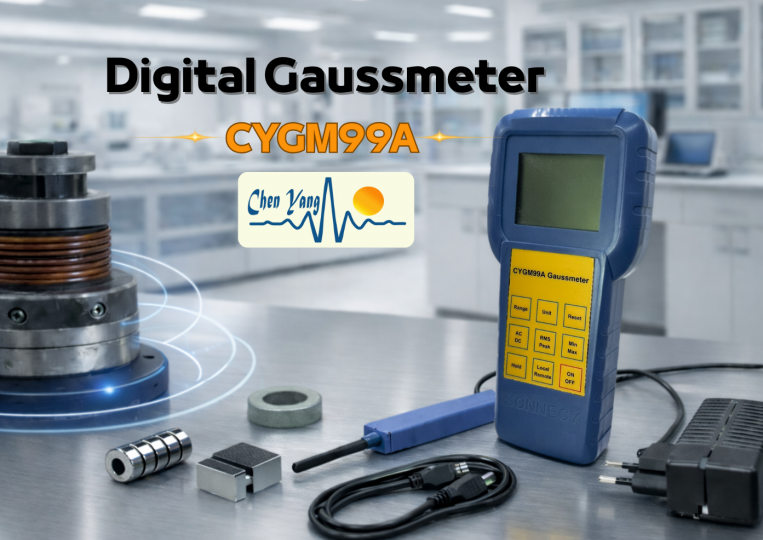
Accurate magnetic field measurement is an essential part of many engineering and testing tasks. Whether evaluating permanent magnets, checking motor air gaps, or verifying magnetic sensors, reliable field data is critical for understanding system behavior and ensuring consistent performance. The CYGM99A digital gaussmeter is designed as a practical measuring instrument for these everyday scenarios. With a clear digital interface, flexible probe options, and measurement functions tailored to real engineering workflows, it supports efficient and repeatable magnetic field measurements across laboratory, production, and field environments.
This article introduces the CYGM99A gaussmeter and focuses on:
1. Why Gaussmeters Matter in Practical Magnetic Measurements
- Is a permanent magnet delivering the expected field strength?
- How uniform is the magnetic field across a surface or air gap?
- Does a motor or actuator operate within its intended magnetic design range?
- Are magnetic sensors responding correctly to applied fields?
2. Introducing the CYGM99A Digital Gaussmeter
The CYGM99A is a general-purpose, engineering-grade digital gaussmeter designed for practical magnetic field measurements in laboratory, production, and field environments. Rather than targeting a single niche application, it is intended as a versatile measuring tool that supports a wide range of everyday magnetics tasks with consistent accuracy and ease of use.
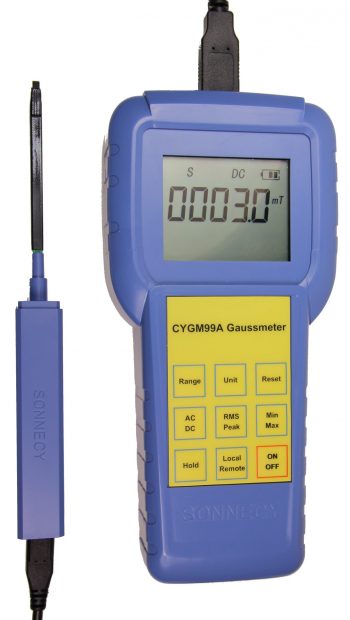
From an application perspective, the CYGM99A is well suited for engineers, technicians, and researchers who need reliable, repeatable magnetic field data without complex setup or specialized instrumentation. In practice, typical users include magnet and motor designers, test and quality engineers, sensor developers, and laboratory staff working with magnetic components or systems.
Signal Processing and Usability
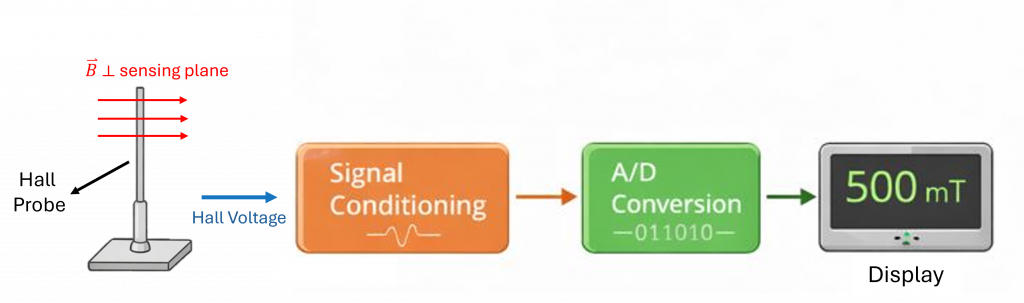
To support reliable measurements in everyday use, the CYGM99A follows a clear and robust signal processing path. First, the magnetic field sensed by the Hall probe is converted into an electrical signal. Next, the signal is conditioned for stability and then digitized. Finally, the meter displays the result as a numerical field value. Therefore, magnetic field information is presented in a clear, repeatable, and easy-to-read form during operation.
Overall, the CYGM99A combines accuracy, usability, and flexibility in a single instrument. Therefore, it is a practical choice for engineers who require dependable magnetic field measurements across different applications and working environments.
3. Key Specifications of CYGM99A Gaussmeter
CYGM99A Digital Gaussmeter – Technical Summary
| Specification | Value / Details |
|---|---|
| Magnetic Field Type | DC & AC magnetic field measurement |
| Measuring Ranges |
0–50 mT, 0–200 mT, 0–500 mT, 0–2000 mT (depends on Hall probe) |
| Resolution |
0.001 mT, 0.01 mT, 0.1 mT (depending on range) |
| Accuracy |
DC: ±1.0 % typical AC: ±2.0 % typical |
| Supported Units | mT (milliTesla) / Gs (Gauss) |
| AC Frequency Range | 10 Hz – 10 kHz |
| Probe Types |
Axial & Transverse Hall probes (selectable) |
| Display | 5-digit LCD |
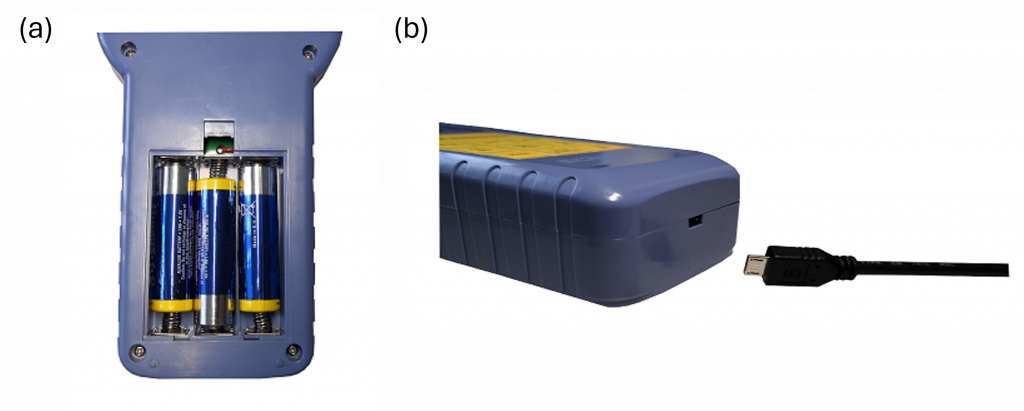
| Power Supply | 3 × AA batteries or USB +5 V |
| Operating Temperature | +5 °C to +50 °C |
| Storage Temperature | −20 °C to +70 °C |
Axial and Transverse Hall Probes — Choosing the Right Orientation
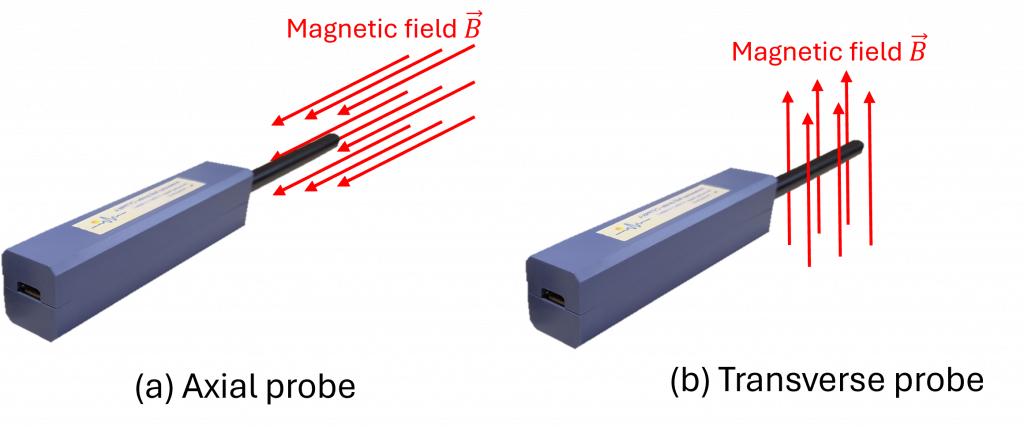
In practical magnetic field measurements, the choice of Hall probe orientation is just as important as the gaussmeter itself. Therefore, the CYGM99A supports both axial and transverse Hall probes, allowing the instrument to adapt to different magnetic field directions and measurement geometries. An axial probe measures the magnetic field component along the probe axis. For example, it is typically used when the magnetic field enters or leaves a surface in a normal direction, such as surface measurements on permanent magnets or magnetic pole faces. By contrast, a transverse probe measures the magnetic field component perpendicular to the probe axis. Accordingly, this configuration is well suited for applications where the magnetic field runs laterally, for instance in motor air gaps or near coils and magnetic circuits.
Flexible Power Supply Options for Different Use Cases
4. Measurement Functions of the CYGM99A
The CYGM99A offers a comprehensive set of measurement functions that can be selected directly via the front-panel buttons. As a result, this layout enables fast, intuitive operation without menu navigation. Meanwhile, during measurement, the LCD display provides real-time feedback on the active mode (DC/AC), polarity, units (mT/Gs), Min/Max or Hold status, and battery condition—so that users always know both what is being measured and how it is being evaluated. In addition, the figure below highlights the two key elements of the user interface.
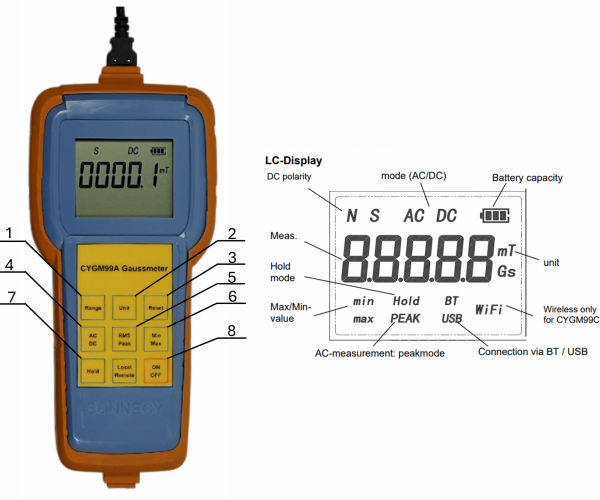
The numbered buttons correspond to the functions described below.
- Range: Selects the measurement range (e.g., ×1 / ×10). Proper range selection helps balance resolution and headroom for different field strengths.
- Unit: Switches the display unit between mT and Gs, allowing quick adaptation to application or regional preferences.
- Reset: Resets the current measurement reference. This is useful when starting a new measurement sequence or comparing multiple points under the same conditions.
- AC / DC: Selects DC measurement for static magnetic fields or AC measurement for time-varying magnetic fields.
- RMS / Peak: In AC mode, it chooses how the magnetic field is evaluated: RMS for effective value or Peak for maximum amplitude.
- Min / Max: Captures and displays the minimum and maximum magnetic field values detected during a measurement interval—ideal for scanning or non-uniform fields.
- Hold: Freezes the current reading on the display, enabling convenient readout after the probe is moved away from the measurement position.
- ON / OFF: Turns the instrument on or off.
Together, these controls allow the CYGM99A to adapt quickly to different measurement tasks while keeping the operating workflow simple and efficient. For a complete description of all operating modes, indicators, and advanced functions, please refer to the CYGM99A User’s Manual and datasheet, where full details are provided.
5. Typical Measurement Scenarios
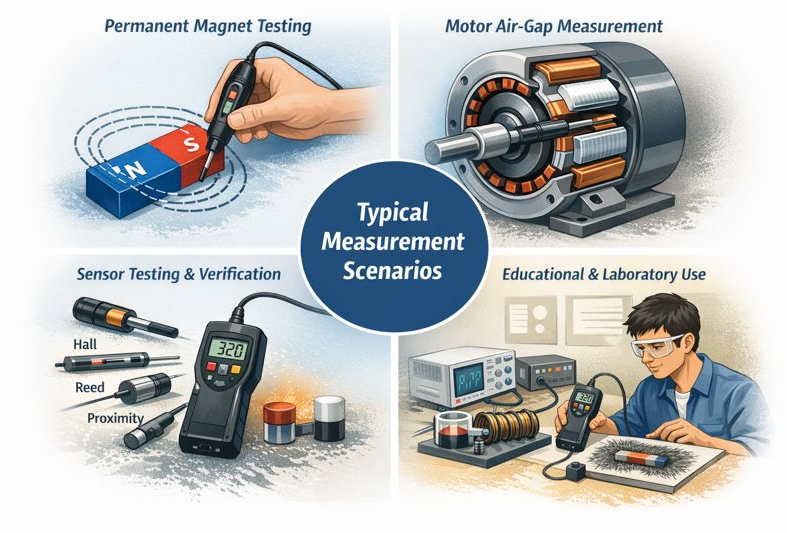
Beyond basic magnetic field readout, the CYGM99A is designed to support a wide range of practical measurement scenarios encountered in engineering, testing, and educational environments. The following examples illustrate how the instrument is commonly used to analyze magnetic fields in real-world applications.
5.1 Permanent Magnet Characterization
One of the most common use cases of the CYGM99A is the characterization of permanent magnets. In practice, typical tasks include measuring surface magnetic field strength, scanning field distribution along a defined path, and comparing multiple magnet samples for consistency and quality control. For example, by moving the probe across the magnet surface or along an air gap, users can quickly identify field uniformity, peak values, and polarity orientation—especially when the Min / Max capture function is enabled.
5.2 Motor Air-Gap Field Measurement
In electric motors, generators, and actuators, understanding the magnetic field inside the air gap between stator and rotor is essential for performance evaluation and troubleshooting. Therefore, with an appropriate transverse probe, the CYGM99A allows direct measurement of the relevant magnetic field component in these confined geometries. In practice, such measurements are commonly used during motor development, fault analysis, or verification of magnetic circuit design assumptions.
5.3 Sensor Testing and Verification
The CYGM99A is also well suited for testing and verifying magnetic sensors, including Hall-effect sensors, reed switches, and proximity sensors. For example, by applying controlled magnetic fields and observing sensor response, users can perform functional checks, threshold verification, and comparative testing under reproducible conditions. As a result, the instrument becomes a practical tool for both development work and incoming/outgoing inspection.
5.4 Educational and Laboratory Applications
In educational and laboratory settings, the CYGM99A serves as an effective tool for demonstrating magnetic field concepts and supporting hands-on experiments. In particular, typical applications include physics laboratory courses, teaching demonstrations, and student projects, where a clear numerical readout and intuitive operation help bridge the gap between theoretical concepts and real-world magnetic field behavior.
6. Conclusion
Digital gaussmeters play a central role in practical magnetic field measurement, bridging the gap between theoretical magnetic concepts and real-world engineering applications. From permanent magnets and electric machines to sensors and laboratory setups, they provide a quantitative and repeatable way to observe magnetic fields that would otherwise remain invisible.
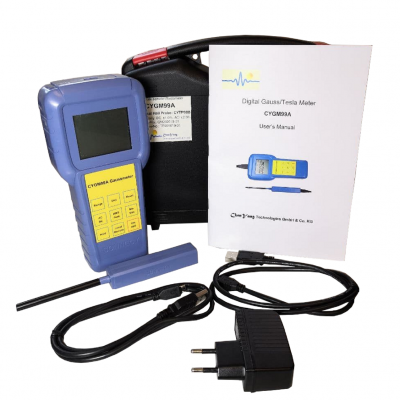
CYGM99A is positioned as a general-purpose, engineering-grade digital gaussmeter, designed for reliable day-to-day use across a wide range of measurement scenarios. Rather than focusing on a single niche application, it supports common industrial and educational tasks through flexible probe options, clear readout modes, and robust handling of both DC and AC magnetic fields.
Across all applications discussed in this article, three core takeaways stand out:
- Understand magnetic field direction — magnetic fields are vector quantities, and measuring results are only meaningful when the field orientation is clearly considered.
- Select the appropriate probe — axial and transverse probes are not interchangeable; choosing the correct probe geometry is essential for accurate measurements.
- Interpret measurement results correctly — numerical values must always be read in the context of probe orientation, field distribution, and measurement mode.
Together, these principles form the foundation of reliable magnetic field measurement with CYGM99A. For detailed specifications and technical parameters, please refer to the datasheet or the product page.