SmCo vs. NdFeB Magnets: Performance, Temperature Limits and Supply Considerations
Shuang Qiu Comments 0 Comment
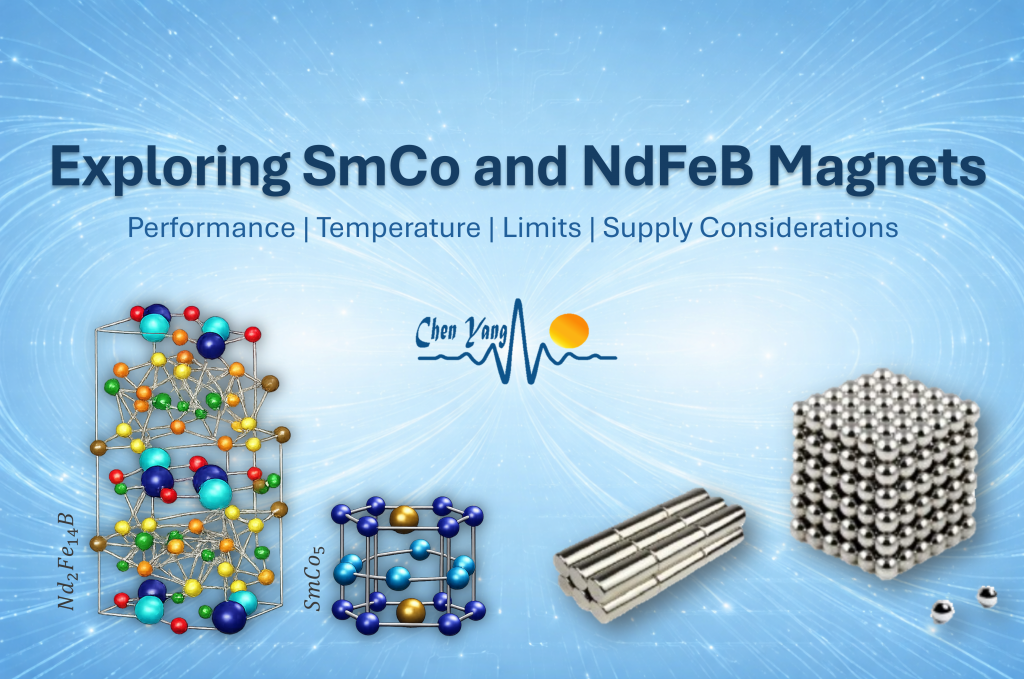
In many engineering applications, the selection of permanent magnet materials, including SmCo and NdFeB magnets, has long followed established conventions. Among these, samarium cobalt (SmCo) magnets are often chosen by default due to their well-known advantages, including high temperature capability, excellent corrosion resistance, and strong long-term stability. These properties have made SmCo a trusted solution in demanding environments such as aerospace, automotive, and industrial systems.
However, recent developments are challenging this traditional preference.
First, the global supply of samarium and cobalt has become increasingly unstable. Geopolitical factors, export restrictions, and rising raw material costs have led to significant price fluctuations and longer lead times. As a result, relying on SmCo magnets is no longer always the most economical or secure option.
At the same time, neodymium iron boron (NdFeB) magnet technology has advanced considerably. Modern NdFeB magnets offer higher magnetic energy density and, with improved material grades and thermal treatments, can now operate reliably at moderately elevated temperatures. In addition, the availability of various protective coatings has significantly enhanced their corrosion resistance, addressing one of their traditional weaknesses.
In this article, we compare the technical properties of SmCo and NdFeB magnets and discuss when NdFeB can serve as a practical alternative.
1. Overview of SmCo and NdFeB Magnets
SmCo Magnets
Samarium cobalt (SmCo) magnets are among the earliest developed rare-earth permanent magnets and are known for their robustness in extreme environments.
Key Properties: Excellent temperature stability; good corrosion resistance; relatively brittle; high cost due to cobalt and samarium content.
Typical Applications: Aerospace systems; military equipment; high-temperature sensors.
SmCo magnets are particularly valued in applications where thermal stability and long-term reliability are critical, even under harsh environmental conditions.
NdFeB Magnets
Neodymium iron boron (NdFeB) magnets represent the most widely used rare-earth magnets today, especially in high-performance and cost-sensitive applications.
Key Properties: Strongest commercially available permanent magnets; very high magnetic energy density; suitable for a wide range of operating temperatures with appropriate material grades; adaptable to various environments through surface protection solutions.
Typical Applications: Motors; sensors; automation equipment; consumer electronics.
NdFeB magnets are the preferred choice when maximum magnetic strength and compact design are required, particularly in modern electrical and electronic systems.

While both materials belong to the rare-earth magnet family, their performance characteristics and practical considerations differ significantly. The difference in magnetic performance and temperature stability between NdFeB and SmCo magnets originates from their crystal structures and intrinsic material properties.
NdFeB magnets are based on the Nd₂Fe₁₄B crystal structure, which enables extremely high magnetic energy density. The strong magnetic contribution of iron atoms allows NdFeB magnets to achieve the highest magnetic energy product among commercially available permanent magnets. This material system is optimized for high magnetic performance and can be adapted to a wide range of operating conditions through different material grades. By selecting appropriate grades, NdFeB magnets can reliably operate in many industrial applications, including those with moderately elevated temperatures.
SmCo magnets, on the other hand, are based on SmCo₅ or Sm₂Co₁₇ crystal structures. These materials have a much higher Curie temperature, typically in the range of 700–800 °C, which results in excellent thermal stability and resistance to demagnetization at elevated temperatures. 2:17 samarium cobalt magnets have a lower temperature coefficient and better corrosion resistance, while 1:5 samarium cobalt magnets have better mechanical properties and ductility.
2. Technical Comparison: SmCo vs. NdFeB Magnets
For engineering decision-making, a structured comparison of key material properties provides the most practical overview. The table below summarizes the most relevant differences between SmCo and NdFeB magnets:

2.1 Magnetic Performance
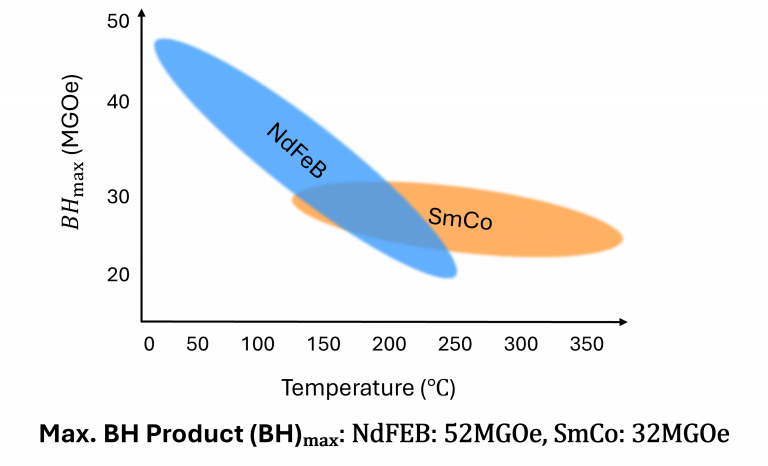
NdFeB magnets offer the highest magnetic energy product (BHmax) among all commercially available permanent magnets. This means they can generate stronger magnetic fields in a smaller volume, enabling more compact and efficient designs.
In contrast, SmCo magnets have a lower energy density than that of NdFeB Magnets, which typically requires larger magnet volumes to achieve the same magnetic performance.
2.2 Temperature Resistance
SmCo magnets offer superior high-temperature performance and remain stable well above 200 °C. This makes them the preferred choice for applications operating in continuously elevated or extreme thermal environments.
For NdFeB magnets, temperature capability is strongly dependent on the material grade. The naming system follows the format:
Nxx + temperature suffix
The number xx indicates the maximum energy product (BHmax) of the magnet. The temperature suffix indicates improved thermal stability.
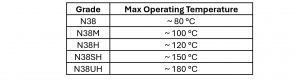
As shown, standard grades (e.g., N38) are typically limited to around 80 °C, while higher-temperature grades such as H, SH, and UH can extend the operating range up to approximately 180 °C. This means that even NdFeB magnets can operate at relatively high temperatures if the appropriate grade is selected.
2.3 Corrosion Behavior
SmCo magnets have inherent corrosion resistance and can typically be used without additional surface protection, even in moderately harsh environments. NdFeB magnets, depending on the application environment, are typically used with protective coatings and therefore can be effectively applied in a wide range of industrial conditions. Common coating options include:
- nickel plating: the most commonly used option, offering a good balance between corrosion protection, durability, and appearance, making it suitable for general industrial and electronic applications.
- epoxy coating: offers superior resistance against moisture, salt spray, and chemicals, making it ideal for outdoor or harsh environments; however, it is less mechanically robust and can be damaged by abrasion.
- zinc coating: provides basic protection at a lower cost, but is less durable and typically used in less demanding environments.
- phosphate coating: is mainly used as a temporary or auxiliary protection layer and is often combined with additional sealing or system-level protection.
2.4 Cost and Availability
NdFeB magnets are generally more cost-effective and easier to source. Their large-scale production and broader supply base make them widely available with shorter lead times and more stable pricing.
In contrast, SmCo magnets rely on more limited raw materials, which results in higher costs and less predictable availability.
3. Current Supply Challenges for SmCo Magnets
The global supply of rare-earth materials is highly concentrated geographically, with China currently holding a near-monopoly on the supply and processing of the rare-earth materials required for SmCo magnets. This concentration creates a strong dependency on China throughout the global SmCo supply chain.
The map below illustrates this geographic imbalance. Although rare-earth materials are mined in several countries, global production is concentrated in only a limited number of regions, with China occupying a particularly dominant position.

This dependency has become particularly critical since April 2025, when China imposed strict global export restrictions on certain rare-earth materials. These controls explicitly cover samarium metal, samarium-cobalt alloys, and samarium-cobalt permanent magnet materials. Exporters are required to obtain the relevant export licenses before these materials can be shipped internationally. In practice, these restrictions can make importing SmCo magnets significantly more difficult and, in some cases, even impossible.
For companies that rely on SmCo magnets as critical components, this situation represents a significant supply-chain risk. Longer and less predictable lead times may result in material shortages and, in the worst case, production delays or even production stoppages.
To mitigate this risk, companies should evaluate whether NdFeB magnets can be used as an alternative in their specific applications. In many cases, transitioning to NdFeB magnets may provide a more practical and reliable solution than trying to secure a stable supply of SmCo magnets under the current export restrictions.
👉 Evaluating NdFeB as an alternative to SmCo is therefore becoming an increasingly important part of supply-chain risk management.
4. When NdFeB Magnets Can Replace SmCo
Although SmCo magnets are often associated with high reliability and thermal stability, there are many practical applications where NdFeB magnets provide an equally suitable — and often more efficient — alternative.
Understanding these scenarios allows engineers to optimize both performance and cost, rather than relying on material choice by habit.
4.1 Applications with Moderate Temperatures
In many industrial and electronic systems, operating temperatures remain well below extreme conditions.
Typical examples include:
- Industrial automation systems
- Position and angle sensors
- Electric motors (standard operating conditions)
- Measurement and control equipment
In these environments, temperatures typically stay below approximately 150 °C, which is within the operating range of common NdFeB material grades — particularly H and SH grades.
Importantly, these grades are generally not affected by current export restrictions, making them a reliable and accessible choice for many applications. By contrast, higher temperature grades (such as UH and above), which require additional heavy rare earth elements, are currently subject to export limitations.

👉 Key takeaway:
For the vast majority of industrial applications operating below 150 °C, NdFeB magnets (especially SH grades) are not only technically suitable, but also more secure from a supply chain perspective.
For a more detailed overview of magnetic properties and material specifications, please refer to our NdFeB material grades overview.
4.2 Applications Requiring High Magnetic Strength
NdFeB magnets offer significantly higher magnetic performance (higher energy product, BHmax) compared to SmCo.
This makes them particularly attractive in applications where:
- Space is limited
- High torque or force is required
- System efficiency is critical
In such cases, NdFeB enables:
- Smaller magnet dimensions for the same performance
- Higher efficiency in motors and actuators
- Reduced system weight and material usage
4.3 Systems with Protective Coatings
A common concern with NdFeB magnets is their susceptibility to corrosion. However, in many real-world applications, environmental conditions are not extreme and can be effectively managed through appropriate surface protection.
Typical operating conditions include:
- Moderate humidity
- Indoor or protected environments
- Controlled industrial settings
In such cases, selecting the right coating is sufficient to ensure stable long-term performance.
Common Coating Options for NdFeB Magnets
- Nickel (Ni) plating
The most widely used option, offering a good balance between corrosion resistance, mechanical durability, and cost.
Suitable for most standard industrial and electronic applications. - Epoxy coating
Provides enhanced resistance against moisture and chemically aggressive environments.
Recommended for applications with higher humidity or occasional exposure to water.
Practical Selection Guidance
To support application design, the following simplified guideline can be used:

Other coatings such as zinc or phosphate are also available, typically used for basic protection or specific industrial requirements. However, they are less common in precision applications and offer lower corrosion resistance compared to nickel or epoxy coatings.
👉 Key takeaway:
Corrosion is often perceived as a major limitation of NdFeB magnets. In practice, however, it can be effectively mitigated through proper coating selection.
For the majority of industrial applications, standard nickel plating is already sufficient, while epoxy coatings provide additional safety margins in more demanding environments.
Conclusion
SmCo magnets remain indispensable in applications where operating conditions are truly demanding.
They are the preferred choice when:
- Extremely high temperatures are present
- Harsh or highly corrosive environments cannot be avoided
- Maximum long-term stability is critical
However, these conditions represent only a subset of real-world applications.
In many modern industrial systems, NdFeB magnets provide a highly practical and efficient alternative — particularly when:
- Operating temperatures remain below approximately 150 °C
- The environment is controlled or within standard industrial conditions
In such cases, NdFeB magnets enable engineers to achieve strong magnetic performance while optimizing system size, efficiency, and cost.
👉 Final perspective:
Evaluating NdFeB magnets as an alternative is not only a technical decision, but also a strategic one. It can help companies improve supply security, reduce costs, and maintain reliable system performance in an increasingly constrained global market.
At ChenYang Technologies, we supply custom permanent magnets tailored to specific application requirements. Our portfolio includes different magnetic materials such as NdFeB, SmCo, AlNiCo, and ferrite magnets, available with various coating options to achieve the required corrosion resistance and long-term performance.
For more details about available NdFeB magnet solutions, please visit our
👉 NdFeB Magnet Product Page
If you are currently experiencing difficulties sourcing SmCo magnets or are considering NdFeB magnets as an alternative, please contact us. Our team can provide technical consultation and support in evaluating whether a substitution is suitable for your specific application and requirements.
👉 Contact Form